

Bodystat 1500 vs InBody 270
Bodystat 1500 and InBody 270: compare documented specifications, features and limitations. Check the reports and explanation offered by the provider. More features alone do not establish better accuracy.

Bodystat 1500: when to consider it
Bodystat 1500 is a portable 50 kHz BIA analyser. Using entered weight, height and other information, it estimates fat, fat-free mass and total body water. Hand-and-foot electrode testing is supine; this designation is distinct from 1500MDD.
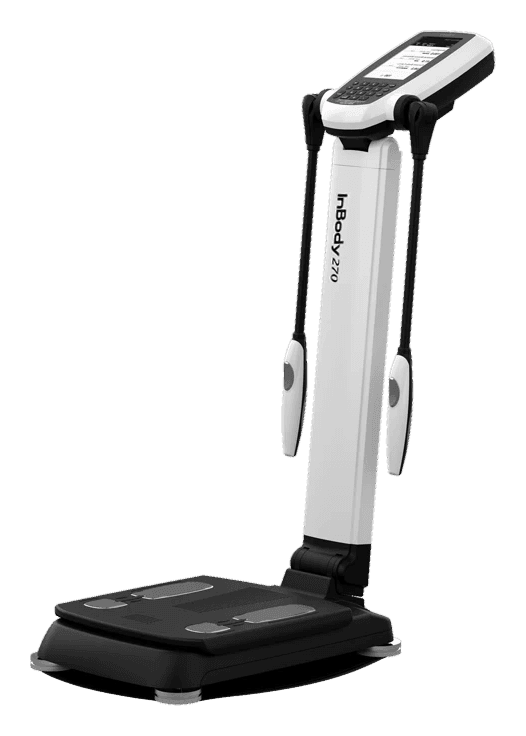
InBody 270: when to consider it
The original InBody270 gives a quick overview of fat, muscle and their distribution. It suits regular diet and training consultations, including testing at different locations. Its output coverage differs from the newer 270S.
Specifications side by side
Highlighted rows differ. Unknown values stay unknown.
| Specifications | Bodystat 1500 | InBody 270 |
|---|---|---|
| Method | Bioelectrical impedance (BIA) | Not verified |
| Measurement frequencies | 50 kHz | 20, 100 kHz |
| Measurement position | Supine | Standing |
| Documented outputs | Estimated fat, fat-free mass and total body water; impedance | Not verified |
| Recording time | Not verified | ≈ 15 s |
| Body weight range | Not verified | 10–250 kg |
| Height range | Not verified | 95–220 cm |
| Device weight | Not verified | 14 kg |
| Contact electrodes | Not verified | 8 |
| Operating temperature | Not verified | 10–40 °C |
| Dimensions (width × depth × height) | Not verified | 356 × 796 × 995 mmEvidence |
| Age in the cited catalogue | Not verified | 3–99 yearsEvidence |
| Impedance measurements | Not verified | 10Evidence |
| Device internal database capacity | Not verified | 100,000 recordsModel sources |
| Display | Not verified | 7″ colour touchscreen LCD, keypadModel sources |
| Display diagonal | Not verified | 7″Model sources |
| Documented interfaces | Not verified | RS-232C, USB, LAN, Bluetooth, Wi-FiModel sources |
| Electrodes | Not verified | 8 contact points on hands and feetModel sources |
| Report types | Not verified | Adult, child and optional thermal reportsModel sources |
Fat-free mass is not pure muscle mass. A single result is not a diagnosis. Different devices and similarly named metrics may use definitions that are not interchangeable.
Sources and verification
- Bodystat — 1500 Instructions for Use
- Nutriamb, Jindřichův Hradec — měření InBody 270
- InBody 270 — originální katalog BC-ENG-83-D-220121
- InBody 270 — český uživatelský manuál
- InBody Japan — změna specifikace 270 → 270S (12. 11. 2024)
- InBody USA — The InBody Test
- Ne hladu — měření InBody230 a 270 / InBody230 and 270 testing
- InBody Japan — BIA and InBody history
- InBody — historie modelů 230 a 270 / history of models 230 and 270