

ACCUNIQ BC720 vs Tanita BC-1000
ACCUNIQ BC720 and Tanita BC-1000: compare documented specifications, features and limitations. Check the reports and explanation offered by the provider. More features alone do not establish better accuracy.
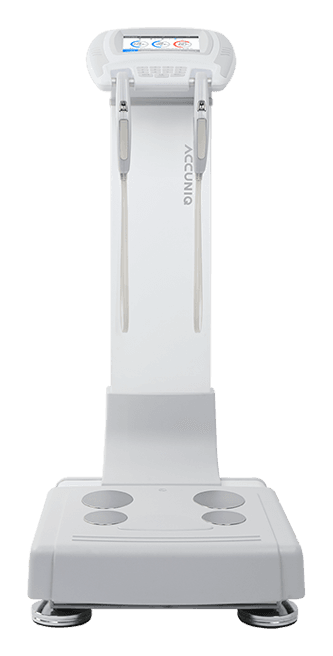

ACCUNIQ BC720: when to consider it
ACCUNIQ BC720 uses multi-frequency BIA with eight contact electrodes. Results include estimated whole-body and regional fat and muscle for the arms, legs and trunk. BC720 also reports extracellular water and phase angle.
Tanita BC-1000: when to consider it
BC-1000 is a body-composition scale that transmits results wirelessly to a compatible receiver. Its manual lists fat, muscle and body water; capacity is 200 kg. BC-1000 Plus is a different version; accessories may vary in a package labelled “PROFI”.
Specifications side by side
Highlighted rows differ. Unknown values stay unknown.
| Specifications | ACCUNIQ BC720 | Tanita BC-1000 |
|---|---|---|
| Method | Multi-frequency BIA | Bioelectrical impedance (BIA) |
| Measurement frequencies | 1, 5, 50, 250, 550, 1000 kHz | Not verified |
| Electrodes | 8 contact electrodes | Not verified |
| Maximum weight | 270 kg | 200 kg |
| Measured regions | Both arms, both legs and trunk | Not verified |
| Documented outputs | Not verified | Body fat, muscle mass and body water |
| Result display | Not verified | Compatible wireless receiver / external display |
Fat-free mass is not pure muscle mass. A single result is not a diagnosis. Different devices and similarly named metrics may use definitions that are not interchangeable.