

Bodystat 1500 vs InBody 520
Bodystat 1500 and InBody 520: compare documented specifications, features and limitations. Check the reports and explanation offered by the provider. More features alone do not establish better accuracy.

Bodystat 1500: when to consider it
Bodystat 1500 is a portable 50 kHz BIA analyser. Using entered weight, height and other information, it estimates fat, fat-free mass and total body water. Hand-and-foot electrode testing is supine; this designation is distinct from 1500MDD.
InBody 520: when to consider it
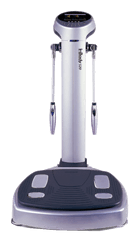
An older model for following fat, muscle and water during nutrition or exercise changes, and for understanding past results. Includes ECW/TBW and lean-mass distribution across the arms, legs and trunk.
Specifications side by side
Highlighted rows differ. Unknown values stay unknown.
| Specifications | Bodystat 1500 | InBody 520 |
|---|---|---|
| Method | Bioelectrical impedance (BIA) | Not verified |
| Measurement frequencies | 50 kHz | 5, 50, 500 kHz |
| Measurement position | Supine | Standing |
| Documented outputs | Estimated fat, fat-free mass and total body water; impedance | Not verified |
| Recording time | Not verified | 50 s |
| Body weight range | Not verified | 10–250 kg |
| Height range | Not verified | 95–220 cm |
| Device weight | Not verified | 26 kg |
| Contact electrodes | Not verified | 8 |
| Operating temperature | Not verified | 10–40 °C |
| Dimensions (width × depth × height) | Not verified | 522 × 843 × 1,015 mmEvidence |
| Age in the cited catalogue | Not verified | 3–99 yearsEvidence |
| Impedance measurements | Not verified | 15Evidence |
| Display | Not verified | Colour LCD, 640 × 480 pixelsEvidence |
| Documented interfaces | Not verified | RS-232C, USB Host, USB Slave and EthernetEvidence |
| Measured regions | Not verified | Right and left arm, trunk, right and left legModel sources |
| Weighing | Not verified | Built-in weighing platform; height is enteredModel sources |
| Results | Not verified | Printed report and export through manufacturer softwareModel sources |
Fat-free mass is not pure muscle mass. A single result is not a diagnosis. Different devices and similarly named metrics may use definitions that are not interchangeable.