

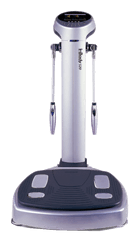
InBody 520
An older model for following fat, muscle and water during nutrition or exercise changes, and for understanding past results. Includes ECW/TBW and lean-mass distribution across the arms, legs and trunk.
Documented locations are available in Czechia.
When this test is useful
Your weight can stay the same while your fat or water changes. The InBody 520 helps separate these changes and adds lean-mass results for the arms, legs and trunk. A series of tests on the same device under similar conditions, discussed during a consultation, is most useful. This is an older generation, distinct from the newer 580 series. Testing is still available at some locations.
What the results tell you
Body fat percentage tells you what share of your weight is fat. Read it alongside fat in kilograms and estimated muscle. Lean mass also includes water, organs and other tissues, so it is not the same as pure muscle. A rapid change does not necessarily mean you gained or lost muscle tissue within a few days.
Segmental lean analysis helps you follow the distribution between your right and left side. Check a difference again at your next visit with correct posture and electrode contact. A leg result includes water and other lean tissues; it does not show strength or explain the cause of an imbalance on its own.
ICW means water inside cells, ECW means water outside them and TBW is their sum. These estimates add context to changes in weight, fat and lean mass. A water change can move the lean-mass estimate without an equivalent gain in muscle tissue.
The ECW/TBW ratio shows the extracellular share of total body water. Read it alongside water amounts and the testing circumstances. A result outside its reference range does not by itself confirm oedema, dehydration or another condition; an unusual result benefits from professional assessment.
BMI uses weight and entered height. Estimated basal metabolic rate describes resting energy needs, rather than total daily expenditure or an exact eating plan. Training, work and everyday movement contribute separately to your actual energy needs.
How the device measures
You stand barefoot on the weighing platform and hold the hand electrodes. The device measures weight and records electrical impedance in the arms, legs and trunk at three frequencies. It uses these values to estimate body water and composition. It does not weigh fat or muscle separately or create an image of them.
Test procedure and preparation
Arrive under conditions similar to your previous test: a similar time of day, interval after meals and your usual fluid intake. Avoid testing straight after training, use the restroom first and stand quietly for a while. Remove heavy accessories and test barefoot. BIA is not performed with a pacemaker or another active implant; discuss pregnancy and other medical circumstances with the location beforehand.
Limitations and influences
The 520 specification and standard report do not document phase angle. Do not assume this output is available because another InBody model provides it. You need to stand steadily and hold the electrodes correctly. Testing while lying down requires a different device series. Establish a new baseline when switching to a newer model. A difference between devices is not automatically a change in your body.
Choosing a device and service
The 520 provides composition, water and segmental lean mass. The 720 uses a broader frequency set and adds segmental phase angles in research mode. The newer 270S provides whole-body phase angle but has a different range of water outputs. Choose according to the information useful for your goal and whether the location explains it during a consultation.
Specifications: InBody 520
- Recording time
- 50 s
- Body weight range
- 10–250 kg
- Height range
- 95–220 cm
- Device weight
- 26 kg
- Measurement frequencies
- 5, 50, 500 kHz
- Contact electrodes
- 8
- Measurement position
- Standing
- Operating temperature
- 10–40 °C
Additional specifications · InBody 520
- Dimensions (width × depth × height)
- 522 × 843 × 1,015 mm
- Age in the cited catalogue
- 3–99 years
- Impedance measurements
- 15
- Display
- Colour LCD, 640 × 480 pixels
- Documented interfaces
- RS-232C, USB Host, USB Slave and Ethernet
- Measured regions
- Right and left arm, trunk, right and left leg
- Weighing
- Built-in weighing platform; height is entered
- Results
- Printed report and export through manufacturer software
Compare models
Where to get tested
We have not documented testing on this device in this country yet. Other facilities may use it.
Frequently asked questions
Is 520 the same as 580?
No. They are different generations with separate specifications and outputs. Use documentation for the exact model.
Does 520 provide phase angle?
The verified standard outputs do not document it. Do not transfer another InBody model’s capabilities.
Sources and documentation
Show sources
- Biospace — technické podání K130777 / technical submission
- InBody — InBody 520 Quick Installation Guide
- Biospace — InBody 520 User’s Manual (2011)
- MegaFitness — měření InBody 520 / testing service
- Biospace — 510(k) Summary K052646
- ESPEN — Bioelectrical impedance analysis, part I: principles and methods
- ESPEN — Bioelectrical impedance analysis, part II: utilization in clinical practice