

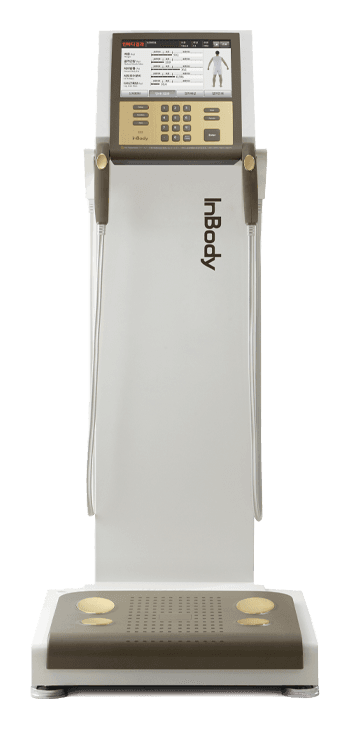
InBody 770S
A newer generation for nutrition and clinical follow-up with a detailed water report. Useful for discussing fat and muscle changes in the context of water distribution and phase angle, including individual body regions.
When this test is useful
The 770S is a newer generation of professional standing analyser, combining muscle and fat assessment with detailed water results. Repeat visits can track individual regions alongside overall changes. The location needs to select a suitable report and explain what its values mean for the particular person. The S designation means more than a different appearance. The catalogue specifies a different measured frequency set, shorter test and lower minimum testing weight than the original 770 manual.
What the results tell you
Skeletal muscle, fat mass and body fat percentage put weight into context. Regional analysis adds distribution between the arms, legs and trunk. For rapid changes in lean mass, also compare water and testing conditions. An InGrip test is a separate source of information about muscle function.
The water report separates water inside and outside cells and their sum, TBW. ECW/TBW expresses the extracellular share. Follow the ratio alongside litres and the trend: a change in proportion need not mean the same change in total volume. Do not infer fluid needs or a diagnosis from the number alone.
Each limb and the trunk can have their own TBW, ICW, ECW and ECW/TBW. This helps assess whether a change concerns the whole body or a particular region. Interpretation is essential: electrode contact, preparation and the person’s condition are part of assessment, not just footnotes below a chart.
Whole-body and five regional phase angles are reported at 50 kHz. The water report also documents BIVA, a graphical display of the body’s electrical properties. Both support professional assessment but do not act as direct immunity tests or a health score for every cell.
The manufacturer’s list includes VFA, VFL, SMI, FFMI and FMI. Visceral fat area and level are different outputs; do not compare their numerical values directly. SMI describes muscle quantity in relation to height, while assessment of possible sarcopenia also needs strength testing and clinical context.
How the device measures
The 770S measures five regions at five frequencies, producing twenty-five impedance values. Phase angles are reported at 50 kHz. Z0 describes impedance at the zero-frequency limit, associated with extracellular water. It is not another frequency in the listed measurements and is not added to the five-frequency count.
Test procedure and preparation
For follow-up, keep a similar time and interval after meals. Maintain usual fluid intake, recover after exercise and use the restroom before testing. Stand quietly and ensure correct hand and bare-foot contact. BIA is not performed with an active implant. Discuss pregnancy and other relevant medical circumstances with the location beforehand.
Limitations and influences
Z0 does not make a clinical decision, and an additional parameter alone does not establish greater accuracy for every client. A 2 kg minimum does not imply newborn testing: specified age, height and standing procedure still apply. Blood pressure or grip on a combined report comes from a separate instrument. BIA itself does not measure them.
Choosing a device and service
The original 770 has six measured frequencies, while the 770S has five and separately described Z0. Compared with the 580, the 770S adds a 1 MHz frequency and a dedicated water report with further outputs. Both already have regional fluid ratios and phase angles. Ask about the report actually available and the purpose of follow-up; a model number alone does not answer those questions.
Specifications: InBody 770S
- Recording time
- ≈ 30 s
- Body weight range
- 2–270 kg
- Height range
- 95–220 cm
- Device weight
- 35.7 kg
- Measurement frequencies
- 5, 50, 250, 500 kHz; 1 MHz
- Contact electrodes
- 8
- Measurement position
- Standing
- Operating temperature
- 10–40 °C
Additional specifications · InBody 770S
- Dimensions (width × depth × height)
- 526 × 854 × 1,175 mm
- Age in the cited catalogue
- From 3 years
- Impedance measurements
- 25
- Device internal database capacity
- 100,000 records
- Display
- 10.2″ colour touchscreen TFT LCD, 800 × 480
- Documented interfaces
- 4× RS-232C, 2× USB host, USB device, Ethernet, Bluetooth and 2.4/5 GHz Wi-Fi
- Display diagonal
- 10.2″
- Result sheets
- Body composition, child and dedicated water reports
- Specialist displays
- The water report includes BIVA and Z0; availability depends on settings
- Additional instruments
- Compatible stadiometer, blood pressure monitor and InGrip
- Result management
- ID, QR, USB backup and LookinBody software according to configuration
Compare models
Where to get tested
We have not documented testing on this device in this country yet. Other facilities may use it.
Frequently asked questions
Is Z0 another measured frequency?
No. It is a modelled limiting impedance at zero frequency, distinct from the frequencies actually measured by the cited revision.
Does a 2 kg lower limit allow newborn tests?
No. The weight limit does not remove age, height or standing and electrode-contact requirements.
Sources and documentation
Show sources
- InBody — český katalog 770S / Czech 770S catalogue (2025)
- InBody — výrobce 770S / manufacturer 770S
- InBody 770S — česká produktová stránka / Czech product page
- InBody — příprava / test preparation
- InBody USA — InBody 770S
- InBody Europe — InBody 770S User Manual
- InBody — Annual Report 2025 / výroční zpráva 2025
- ESPEN — Bioelectrical impedance analysis, part I: principles and methods
- ESPEN — Bioelectrical impedance analysis, part II: utilization in clinical practice
- EWGSOP2 — Sarcopenia: revised European consensus on definition and diagnosis