

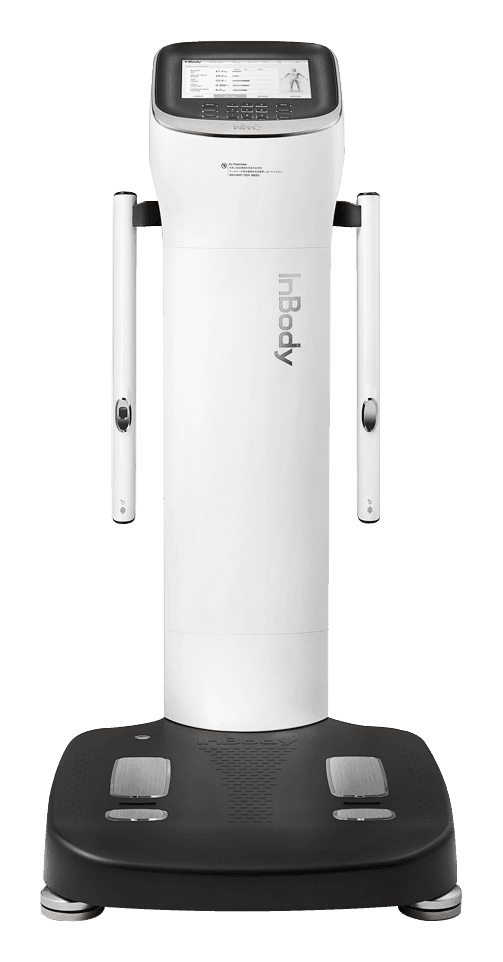
InBody 970S
InBody 970S: BIA body-composition testing
For a comprehensive consultation when you want to follow water distribution and phase angles alongside fat and muscle. This newer 970 generation offers detailed outputs for clinical, nutrition, sports and research settings.
A listing is neither manufacturer endorsement nor an accuracy rating.
A practical guide to the test
Learn what happens during the test, how to prepare and what to ask when booking. Always confirm that the provider offers the specific service.
What InBody 970S measures
For a comprehensive consultation when you want to follow water distribution and phase angles alongside fat and muscle. This newer 970 generation offers detailed outputs for clinical, nutrition, sports and research settings.
Manufacturer specifications describe the model. They do not confirm the report a provider supplies or public service availability.
Specifications: InBody 970S
- Recording time
- ≈ 30 s
- Body weight range
- 2–300 kg
- Height range
- 95–220 cm
- Device weight
- 41.1 kg
- Measurement frequencies
- 5, 50, 250, 500 kHz; 1, 3 MHz
- Contact electrodes
- 8
- Measurement position
- Standing
- Method and electrodes
- DSM-BIA / SMF-BIA; 8 tactile electrodes
- Measured segments
- Right and left arm, trunk, right and left leg
Additional documented technical specifications
- Dimensions (width × depth × height)
- 614.1 × 963.8 × 1,239.3 mmEvidence
- Age in the cited catalogue
- From 3 yearsEvidence
- Impedance measurements
- 30Evidence
- Device internal database capacity
- 100,000 recordsModel sources
- Display
- 10.1″ colour TFT LCD; 1,280 × 800Model sources
- Display diagonal
- 10.1″Model sources
- Documented interfaces
- Wi-Fi, BluetoothModel sources
- Segmental phase angle
- 15 values: 5, 50 and 250 kHz × 5 segmentsModel sources
- Identification at testing
- Fingerprint / InBodyBAND recognitionModel sources
Ages and ranges are documentation entries, not confirmation of suitability for an individual visitor. Dimensions use width, depth, height; pictured accessories may be optional.
How it measures
BIA measures electrical impedance. A model uses this to estimate body composition, including fat and fat-free mass. InBody is a BIA brand, not a separate method. Fluid status can influence the result.
Benefits
- Compare the documented model specifications before choosing a provider.
What the device does not tell you
- Fat-free mass is not pure muscle mass. A single result is not a diagnosis. Different devices and similarly named metrics may use definitions that are not interchangeable.
Compare devices
For tracking change, ask about using the same device and procedure and having the results explained. For clinical examination, confirm referral and booking requirements with the provider. Differences between methods are not automatically changes in your body.
Preparation and comparability
Follow the specific device manual and provider instructions. For repeat BIA, keep time of day and food, activity and fluid conditions similar. Ask the provider about suitability and safety, especially during pregnancy or with implanted electronic devices.
Choose a test →Use and history
Documented use settings
These describe the model context, not available providers or confirmed partnerships.
What to check before choosing
Choose according to the consultation and available reports. A higher model number or a newer year alone does not establish a better result for every goal; build a new baseline when changing devices.
Exact-model history
The Korean manufacturer’s annual report records the 970S launch in August 2024. It is a separate generation from the original 970 launched in 2019; the Czech sales launch date is not established.