

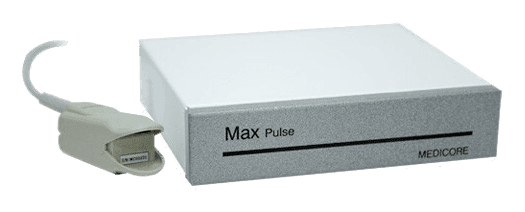
Max Pulse
The Max Pulse records an optical pulse wave from your finger. Alongside pulse rate, it analyses waveform shape and, in a longer test, variation in intervals between pulses. It can add a short resting recording to a consultation; it does not measure composition or blood pressure.
When this test is useful
You sit down, place a small sensor on your finger and stay still for a few minutes. Max Pulse records your pulse wave and the differences in timing between pulses. At a later visit, you can compare the result with your own earlier measurement. The results sheet also includes scores labelled vascular level, stress or fatigue. The software calculates these from the recording. Treat them as additional information: the measurement alone cannot show whether you have arterial disease or determine your psychological state.
What the results tell you
The results sheet shows the vascular levels the software assigned to your recorded pulses. Looking at the whole distribution and your own changes over time is useful. A cold finger or movement can affect the result. A vascular level cannot tell you whether or where an artery is narrowed.
A longer measurement also gives you a variability overview and scores labelled stress, fatigue or autonomic activity. You can return to them and follow your own changes, while considering whether you were rested and used the same recording length. The short 45-second APG mode does not provide these results.
Comparing yourself under similar conditions is most useful. A quiet morning recording can differ from one after training. You can note sleep, exercise or coffee alongside the result to help understand why two visits differ.
How the device measures
The sensor uses light to follow changes in blood flow in your finger. This method is called PPG. The wave’s shape is used for APG analysis, technically its second derivative. The time between pulses is used to calculate pulse rate variability (PRV). The manufacturer labels this results sheet HRV, but the device does not record the heart’s electrical activity as an ECG does.
Test procedure and preparation
Take some quiet time to settle before testing. Support your hand comfortably and let cold fingers warm up. During recording, avoid talking or moving your hand and breathe naturally. Aim for similar conditions next time, including a similar gap after exercise or coffee. Do not stop medication on your own for the test.
Limitations and influences
Blood pressure needs a cuff monitor; Max Pulse does not provide pressure values in mmHg. Optical PPG measurement is not an ECG. Its pulse variability can differ from ECG-derived HRV and is also affected by movement and finger blood flow. Vascular scores cannot show blocked arteries and do not directly measure aortic stiffness. Stress or fatigue scores cannot establish burnout or anxiety. Flagged irregular intervals alone do not confirm an arrhythmia. If you have an arrhythmia or another heart condition, discuss suitability with a clinician. An irregular rhythm can make variability results difficult to interpret.
Choosing a device and service
To find out your blood pressure, you need a cuff monitor such as BPBIO750. Max Pulse adds a view of the optical pulse wave and its intervals. For heart-rhythm concerns, a clinician uses an ECG to record the heart’s electrical activity. Each measurement serves its own purpose.
Specifications: Max Pulse
- Recording time
- 45 s (pulse wave / APG); 3 min (APG + pulse variability); 5 min (APG + pulse variability)
- Operating temperature
- 10–40 °C
- Recorded signal
- Optical pulse wave — PPG
- Sensor
- Finger PPG probe
Additional specifications · Max Pulse
- Documented interfaces
- RS-232, USB–RS-232 cable, computer
- Processing
- Max Pulse computer software
- Power supply in the manual
- 100–240 V AC, adapter
Where to get tested
Locations with a documented device. Each location detail describes its service and conditions.
Piešťanská 1202/44, Nové Mesto nad Váhom
Frequently asked questions
How long does a MAXpulse test take?
APG recording takes 45 seconds; longer modes with outputs labelled HRV take 3 or 5 minutes. An appointment also includes rest and explanation.
Does MAXpulse show blocked arteries?
No. Software vascular levels from the finger sensor neither establish nor rule out narrowed arteries. Symptoms require appropriate assessment.
Sources and documentation
Show sources
- MEDICORE: Max Pulse — User Manual
- Max Pulse: český uživatelský manuál
- PPG-derived pulse rate variability versus ECG-derived heart rate variability
- AHA: Improving and standardizing vascular research on arterial stiffness (2015)
- Medicore / FDA — Max Pulse System, 510(k) summary
- FDA — Max Pulse System, K110374 (2011)
- Mejía-Mejía et al. — Pulse rate variability in cardiovascular health, institutional author manuscript