

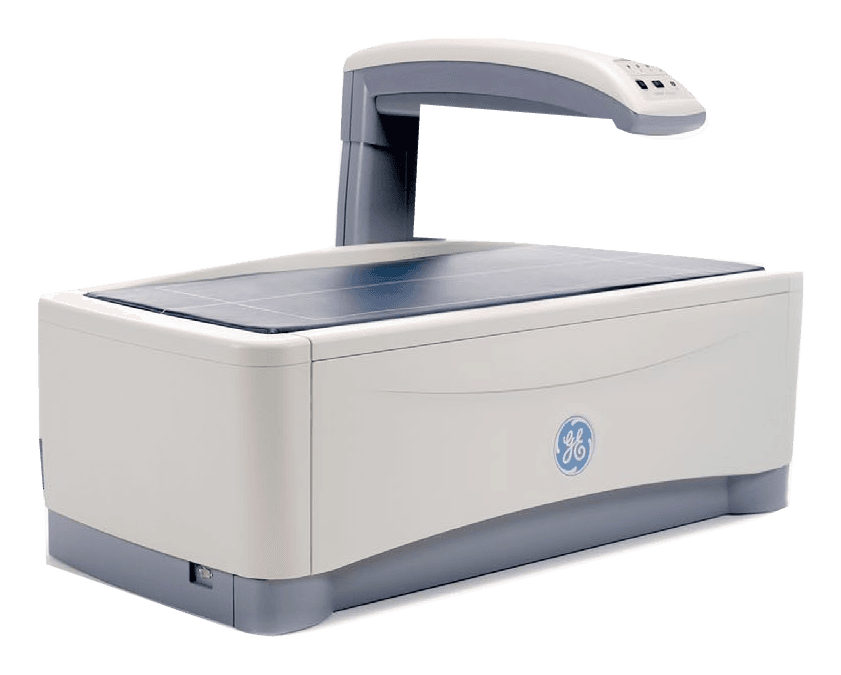
GE Lunar Prodigy
Lunar Prodigy denotes a GE HealthCare DXA family. It supports bone densitometry and, depending on software, body-composition analysis. A base name does not identify the Primo, Pro or Advance package or table size.
Documented locations are available in Czechia.
What the results tell you
Lunar Prodigy denotes a DXA family. Bone examinations evaluate mineral density, while the appropriate whole-body analysis reports fat and lean tissue and fat percentage. The brochure distinguishes Primo, Pro and Advance software packages. The generic name identifies neither package nor table size. When booking, rely on the actual service and report contents rather than the presence of a Prodigy scanner alone.
How the test works
During DXA you lie on a scanning table while the system uses X-rays at two energies. The operator selects position and scan scope for the booked examination. Spine or hip protocols differ from whole-body scanning. Composition software distinguishes fat, lean soft tissue and bone mineral, rather than separately weighing muscle or testing its function.
When the test is useful
Bone densitometry addresses mineral density at examined skeletal sites. Whole-body composition instead supports assessment of fat and lean-tissue distribution. Choose the service according to that goal. Trends benefit from the same system, protocol and analysis; results across manufacturers are not automatically comparable. A professional should interpret findings in relation to the examination’s purpose.
Preparing for your visit
Before booking, disclose possible pregnancy and recent contrast examinations so the location can assess suitability and timing. Follow instructions for clothing and metal objects. For repeat composition testing, keep meals, time of day, activity and bladder-emptying conditions similar. Check the actual table’s size and weight limits if relevant.
Reading results and understanding limitations
DXA body-composition testing is contraindicated in pregnancy. Contrast agents, artifacts, positioning and scan boundaries can affect results. Lean soft tissue is not pure muscle and does not express strength. Small changes must be assessed against the location’s measurement precision. A densitometer’s presence does not establish whole-body services or every optional application.
Choosing a testing location
Ask about package, table size and report contents. Unspecified Prodigy must not be labelled Pro or Advance; the actual service determines suitability for your goal.
Specifications: GE Lunar Prodigy
- Method
- DXA
- Measurement position
- Supine
- Documented outputs
- Bone mineral density; body composition depending on software
- Designation scope
- Family; package and size unspecified
Additional specifications · GE Lunar Prodigy
Compare models
Where to get tested
We have not documented testing on this device in this country yet. Other facilities may use it.
Frequently asked questions
What should I ask about an unspecified Lunar Prodigy?
Ask about package, table size and report contents. Unspecified Prodigy must not be labelled Pro or Advance; the actual service determines suitability for your goal.
Does DXA directly measure muscle strength?
No. Lean soft tissue describes composition rather than strength or performance; muscle function requires an appropriate functional test.