

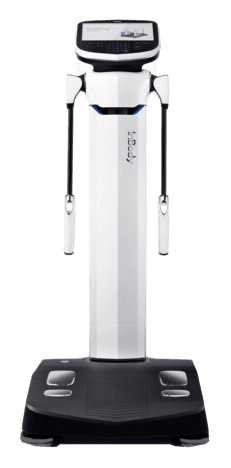
InBody 580
For following fat and muscle with more detail about individual body regions. At a gym, nutrition practice or clinic, regional water ratios and phase angles add context to your consultation.
When this test is useful
The 580 is useful when a usual muscle and fat overview is not enough to understand a change. Alongside whole-body results, it reports extracellular water ratio and phase angle for the arms, legs and trunk. This helps frame more specific questions during a consultation; the analyser does not establish the cause of an unusual difference. Its fixed standing design, large touchscreen and short test suit locations offering regular follow-up. Before your appointment, check which detailed fields the location actually prints or makes available.
What the results tell you
Weight, skeletal muscle and fat help distinguish what changed at the next visit. Segmental lean mass adds limb distribution. It also includes water, so a rapid change cannot automatically be treated as muscle tissue gained or lost.
Whole-body ECW/TBW can be supplemented by the same ratio for individual regions and their estimated ICW and ECW. A local difference need not remain hidden in the overall number. A higher ratio alone does not confirm oedema or tell you to change your fluid intake.
The 580 reports a whole-body phase angle and five regional values at 50 kHz. These are electrical measurements interpreted professionally in relation to age, body build and other results. A low angle alone is not a diagnosis, and an arm-to-trunk difference is not a simple health ranking.
VFA expresses an estimate of fat around internal organs as an area in cm²; the detailed list also includes VFL. Neither is an abdominal scan. For follow-up, compare the same output on the same analyser, rather than comparing VFA directly with the numerical VFL level.
The output list includes SMI, FFMI and FMI. The Czech manual also lists BIVA, a graphical assessment of the body’s electrical properties. A particular chart’s availability depends on the report and software. SMI describes muscle quantity; muscle function needs a separate test, such as grip strength.
How the device measures
Electrical measurements are taken separately in five body regions. Four frequencies produce twenty impedance values. Body composition is derived from these and other inputs. Reported phase angles are at 50 kHz; they are not five additional frequencies.
Test procedure and preparation
For comparable follow-up, choose a similar time of day and interval after meals. Keep your usual fluid intake, avoid testing straight after exercise and use the restroom beforehand. Hold the electrodes correctly and stand still. BIA is not performed with an active implant; discuss pregnancy and other relevant medical circumstances with the location in advance.
Limitations and influences
A more detailed report needs more interpretation. One unusual regional value without context does not establish a medical problem. Testing requires standing and hand and bare-foot contact. Supine testing needs a different device design. BMR, visceral fat and minerals are derived values. They do not replace indirect calorimetry, imaging or bone-density testing.
Choosing a device and service
The portable 380 provides whole-body fluid ratio and phase angle. The 580 extends these to five regions and also reports VFA. The 770S adds a measured 1 MHz frequency and a dedicated water report with further specialist displays. Frequency count alone is not proof of greater accuracy for every person; the purpose of follow-up and interpretation of available results matter.
Specifications: InBody 580
- Recording time
- ≈ 30 s
- Body weight range
- 5–300 kg
- Height range
- 95–220 cm
- Device weight
- 24.4 kg
- Measurement frequencies
- 5, 50, 250, 500 kHz
- Contact electrodes
- 8
- Measurement position
- Standing
- Operating temperature
- 10–40 °C
Additional specifications · InBody 580
- Dimensions (width × depth × height)
- 501.9 × 892.4 × 1,124.4 mm
- Age in the cited catalogue
- From 3 years
- Impedance measurements
- 20
- Device internal database capacity
- 100,000 records
- Display
- 10.1″ touchscreen TFT LCD, 1280 × 800
- Documented interfaces
- 2× RS-232C, 2× USB host, Ethernet, Bluetooth and Wi-Fi
- Display diagonal
- 10.1″
- Hand electrodes
- Three-way grip for consistent hand positioning
- Result sheets
- Body composition, child and thermal reports
- Identification
- Client ID; QR recognition depends on equipment and settings
- Connected tests
- Grip and blood pressure from separate instruments
Compare models
Where to get tested
Locations with a documented device. Each location detail describes its service and conditions.
Frequently asked questions
Which phase angles does 580 provide?
Whole-body and segmental values for arms, legs and trunk at 50 kHz. Check availability on the location’s report.
Is 580 VFA an image of abdominal fat?
No. It is an area estimate from bioimpedance and does not replace CT or other imaging.
Sources and documentation
Show sources
- InBody — katalog 580 / 580 catalogue (2024)
- InBody — česká příručka 580 / Czech 580 manual
- InBody — globální 580 / global 580
- InBody 580 — česká produktová stránka / Czech product page
- InBody — příprava / test preparation
- InBody Germany — InBody präsentiert InBody 380 & InBody 580
- InBody — Annual Report 2025 / výroční zpráva 2025
- ESPEN — Bioelectrical impedance analysis, part I: principles and methods
- ESPEN — Bioelectrical impedance analysis, part II: utilization in clinical practice